Harley FXR Parts & Accessories: Performance, Restoration & Custom Upgrades
Shop aftermarket Harley FXR parts and accessories at Get Lowered Cycles. Whether you're restoring an original FXRS Low Rider, upgrading an FXRT Sport Glide, building a custom FXRP-style motorcycle, or improving the performance of your FXR Super Glide, our selection includes exhaust systems, suspension, seats, handlebars, risers, brakes, carburetors, and more.
The Harley-Davidson FXR remains one of the most respected Big Twin platforms thanks to its rigid frame design, rubber-mounted engine, and responsive handling. Decades after its introduction, the FXR continues to attract riders interested in performance builds, club-style motorcycles, and traditional Harley customization.
What Years and Models Are Harley FXR Motorcycles?
Harley-Davidson introduced the FXR platform for the 1982 model year, with regular production continuing through 1994.
The FXR returned briefly through Harley-Davidson's Custom Vehicle Operations (CVO) program in 1999 and 2000.
Popular FXR models include:
-
FXR Super Glide: The original FXR platform, introduced as the Super Glide II.
-
FXRS Low Rider: A classic FXR configuration known for its low-profile styling.
-
FXRT Sport Glide: A touring-oriented FXR featuring a frame-mounted fairing.
-
FXRP Police: A police-service version that remains popular for custom FXRP-inspired builds.
-
FXLR Low Rider Custom: A factory custom variant with distinctive styling.
-
FXRS-SP Low Rider Sport: A sport-oriented model featuring suspension and chassis equipment tailored to a more aggressive riding style.
-
FXR2 and FXR3: Limited-production CVO models introduced for 1999.
-
FXR4: The final CVO FXR model, produced for 2000.
Although these motorcycles share the FXR family name, wheel configurations, brake components, suspension, bodywork, and other details vary considerably.
Always confirm the exact model and year before ordering replacement or performance parts.
Harley FXR Exhaust Systems
An aftermarket exhaust is one of the most popular upgrades for Harley FXR motorcycles.
Riders frequently choose 2-into-1 systems for performance-oriented builds or traditional 2-into-2 configurations for classic styling.
Popular exhaust manufacturers include Bassani, SP Concepts, and other manufacturers offering compatible systems.
When choosing an FXR exhaust, consider engine configuration, mounting points, passenger peg clearance, ground clearance, and any existing aftermarket modifications.
An exhaust upgrade can change engine performance, but actual horsepower and torque results depend on the complete engine combination and fuel calibration.
Shop Harley FXR Exhaust Pipes
Harley FXR Suspension & Rear Shocks
The FXR earned its reputation partly through its chassis design and handling characteristics. Modern suspension components can help improve ride quality, damping control, and handling when properly selected.
Get Lowered offers aftermarket FXR shock options from manufacturers including RacingBros, Progressive Suspension, and other suspension specialists.
Before selecting rear shocks, consider:
Increasing shock length may raise the rear of the motorcycle and change steering geometry, but proper spring selection and damping remain essential.
For riders building a performance-oriented FXR, rear suspension should be evaluated alongside fork springs, fork condition, and overall chassis setup.
Shop Harley FXR Shocks
Harley FXR Seats & Rider Comfort
An aftermarket seat can improve comfort, change rider position, and complement the overall appearance of a custom FXR.
Popular choices include traditional solo seats, step-up performance seats, and touring-oriented designs.
Step-up seats are frequently used on aggressive custom builds because their raised rear section can provide additional rider support.
Touring-oriented seats generally emphasize support and pressure distribution over extended distances.
Before purchasing, verify the motorcycle's seat mounting points, fuel tank compatibility, rear fender arrangement, and passenger seating requirements.
FXR seats are not universally interchangeable across every year and model.
Shop Harley FXR Seats
Harley FXR Handlebars & Risers
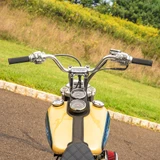
Handlebar upgrades are central to both classic and modern FXR builds.
Common setups include T-bars, motocross-style handlebars, pullback risers, and traditional cruiser bars.
Choosing the correct combination depends on the rider's reach, preferred riding posture, handlebar diameter, and the motorcycle's existing controls.
Important installation considerations include:
-
Handlebar clamping diameter
-
Riser mounting compatibility
-
Brake line length and routing
-
Clutch and throttle cable length
-
Electrical wiring clearance
-
Gauge mounting position
-
Fuel tank clearance at full steering lock
FXR motorcycles originally used cable-operated throttle systems, but extensively modified motorcycles may have different control arrangements.
Always verify the actual motorcycle configuration rather than relying only on the model year.
Shop Harley FXR Handlebars
Shop Harley FXR Risers & Parts
Harley FXR Brakes & Caliper Upgrades
Braking components are another common area of improvement, particularly on older FXR motorcycles.
Depending on the model and existing equipment, riders may consider replacement brake rotors, pads, calipers, and custom brake conversion components.
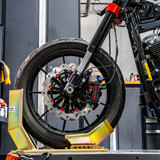
Modern radial brake calipers are sometimes incorporated into performance FXR builds using compatible aftermarket forks, caliper brackets, and hydraulic components.
However, a caliper with the correct mounting pattern does not automatically fit an original FXR front end.
Before changing brake components, verify rotor diameter, offset, caliper alignment, master cylinder compatibility, and wheel clearance.
Shop Harley FXR Brake Parts
Harley FXR Carburetors, Air Cleaners & Engine Performance
The original FXR production run included two major Harley-Davidson Big Twin engine generations:
1982–1983: Early FXR motorcycles used the Shovelhead engine.
1984–1994: The Evolution Big Twin became the principal FXR engine configuration.
The limited-production 1999–2000 CVO FXR models also used the Evolution engine.
This distinction matters because intake manifolds, carburetor arrangements, engine components, and related hardware are not always interchangeable.
Common Evolution FXR modifications include aftermarket carburetors, high-flow air cleaners, ignition upgrades, and camshaft changes.
For modified engines, intake and exhaust components should be selected with the complete engine combination in mind.
Shop Harley FXR Carburetors
Shop Harley FXR Air Cleaners
Harley FXRT & FXRP-Style Fairings
FXRT and FXRP-inspired fairings have become especially popular among riders building modern club-style motorcycles.
These frame-mounted fairing designs combine traditional FXR styling with wind protection and a distinctive touring-inspired appearance.
Depending on the motorcycle, installation may require a dedicated mounting bracket, headlight arrangement, windshield, and additional hardware.
Factory FXRT, FXRP, and aftermarket reproduction components should not be assumed to interchange without modification.
Shop Harley FXR Fairings
Harley FXR Parts Frequently Asked Questions
What years did Harley-Davidson manufacture the FXR?
Regular FXR production ran from 1982 through 1994. Harley-Davidson later produced limited CVO FXR2 and FXR3 models in 1999 and the FXR4 in 2000.
What is the difference between an FXR and a Dyna?
The FXR and Dyna use different chassis designs, mounting arrangements, and suspension configurations. Although they share some engine and drivetrain components depending on year, most chassis-specific accessories are not directly interchangeable.
Will 1982–1983 FXR engine parts fit a 1990 FXR?
Not necessarily. Early FXRs used Shovelhead engines, while a 1990 FXR normally has an Evolution Big Twin. Engine-specific parts must be selected accordingly.
What are the best upgrades for an FXR?
Popular upgrades include improved rear shocks, a properly fitted seat, handlebars and risers, upgraded braking components, and a compatible exhaust system. The best modifications depend on the motorcycle's condition and intended use.
Can I install an FXRT fairing on a standard FXR?
Many FXR models can be converted to FXRT-style fairing arrangements with the correct mounting components. Compatibility depends on the front end, frame, headlight setup, and chosen fairing kit.
Are Harley FXR seats interchangeable between all years?
No. Seat fitment can vary by model year, fuel tank, mounting points, and rear fender configuration.
Can I use Dyna shocks on an FXR?
Some aftermarket shock manufacturers list overlapping FXR and Dyna applications, but compatibility must be confirmed for the exact shock part number and motorcycle. Matching eyelet dimensions alone does not guarantee proper fitment or suspension operation.
Shop Harley FXR Parts at Get Lowered Cycles
Whether you're maintaining an original Evolution FXR, restoring a classic Low Rider, or building a custom FXRT or FXRP-inspired motorcycle, Get Lowered Cycles carries aftermarket parts and accessories for a wide range of FXR applications.
Explore our selection of exhaust systems, suspension, seats, handlebars, risers, brakes, air cleaners, carburetors, fairings, and custom hardware above.
We offer free U.S. shipping with no minimum purchase. Always verify individual product fitment before ordering, particularly on older or heavily modified FXR motorcycles.






 $143.95MSRP: $159.95